May, 2007 Archive


Mariental – Sony Boy’s Place (120 km)

(Namibia, Stockholm-Cape Town 2006/07)

“With the bicycle all that way!? Now that makes a man, uh? I’m a lone farmer, and prospector. Wow, let’s make a fire?!!” By half past nine, Sony Boy as we’d get to know him, came home and welcomed his two surprise guests.

We had, like usual, taken the first turnoff we could find when it started to get dark. Some four kilometers from the main road, it came to a dead end by the railroad tracks. There was a shack of corrugated iron sheets, shaped like a small hangar, but nobody around. So we pitched our tents on the sandy ground, made dinner and went to sleep. When Ben, or ‘Sony Boy’ as he called himself, came home, we were already fast asleep and not that willing to face the cold outside. It was actually the cold that kept us from socializing.

“Sorry, too tired,” I answered (Lina didn’t wake up). “OK, so what do you drink in the morning – coffee or tea?” Ben continued, still excited in his voice of having visitors! “Coffee, please,” I replied. Despite the icy cold outside, I had unzipped a small opening through my tent so we could at least see each others’ faces before going back to sleep.

The next morning, we spend an hour or so with Ben before continuing south. He is 49 years old. He sold his cell phone to buy petrol. Found a meteorite once that gave him 14,000 Namibian dollars – about 1,500 euro. Half of it bought him a metal detector to use in his prospecting – but the batteries are finished now. He invited us for delicious coffee from beans that his brother gave him, and I make us malted grain sorghum (mabele) porridge.

  • Digg
  • del.icio.us
  • Yahoo! Buzz
  • Google Buzz
  • Twitter
  • Facebook
(No Comments)

Koruna Farm – Mariental (130 km)

(Namibia, Stockholm-Cape Town 2006/07)

After stocking up with food and buying some warm socks (it’s getting really cold in the tent now) in Mariental, it’s already pitch dark as we cycle out of town, looking for a place to camp. We take the very first turnoff we can find, and although we can’t see where it leads, we figure to wild camp if we can’t find a house. As long as we are far away from the main road, and make sure nobody see us as we turn off, it should be safe enough. Luckily, after only three kilometers, we see a farm ahead. We meet Hannes and Rehanne, and their twin daughters. They welcome us to sleep inside, and share their dinner.

Their generator has failed recently, but they light up the house with candles, and the shower is heated by a wood fire. Rehanne’s aunt was murdered in September last year by ‘a black man’. She lived in a farm just an hours drive northeast from here. In the surge of this, their daughters don’t dare to walk alone in the dark anymore. Not even take a shower. Rehanne has to join them.

The spin of what remains of colonialism and the apartheid era is difficult for us to understand, and as those in power keep neglecting it, it is also a huge threat to stability in countries like Namibia and South Africa. I asked Hannes if there is any civilization along the road which we will travel tomorrow. “No, there is nothing on that road. Only black people/farmers,” he replies. We have to always remember how we are all humans, and how these wonderful people that hosted us tonight also say things they don’t mean in the sense that we as Europeans interpret them. They’ve been born into a divided society, where things are to be either black or white. Saying what Hannes said doesn’t mean that he regards black people as uncivilized, but only reflects a knowledge that 99% of black farmers are poor in this country, which means that they don’t have big farms – which in turn was what he thought I asked about.

We are grateful for a warm bed. They serve us minced kudu meat for dinner, and a cup of rooibos tea before going to bed. Mealie pap (corn porridge) for breakfast.

  • Digg
  • del.icio.us
  • Yahoo! Buzz
  • Google Buzz
  • Twitter
  • Facebook
(No Comments)

Oamites – Koruna Farm (119 km)

(Namibia, Stockholm-Cape Town 2006/07)

We look at each other, both carefully examining the other. The eyes of the leopard shine from within the dry, knee-high grass, and unmask the else well camouflaged coat of its body. He looks at me as if on guard, his back crouched and his hips tensely risen. We’re only the width of the tarred road apart. I and Lina have cycled five kilometers from where we slept the night; time is just past dawn.

Lina has halted behind me, where a line of cars and minibuses are parked along the roadside and their passengers follow the drama at a safe distance. A minibus had hit the leopard not long ago and it is – although badly injured – aggressive and provoked and, as we will soon be made aware of, still able to attack.

As I came cycling, I had believed that the line of cars was the remains a traffic accident. When I didn’t see any damaged vehicles, I stopped by the end of the line. Noticing the leopard, I became motionless. I leaned my bicycle against a minivan parked just in front of me. But its passengers soon decided to carry on – maybe after realizing the danger of the erratic leopard. I wasn’t late to make the same decision. I turned around and cycled back to where Lina and most of the cars had stopped, to follow the scene from a safe distance.

Although the police soon arrives, and do their best to direct the traffic past the accident, it is at times very unorganized. People walk back and forth as they like, sometimes dangerously close to the leopard in trying to take good pictures to send to friends and relatives.

Since we arrived, the leopard has walked out on the road and occasionally attacked the cars and trucks that pass by. At least two of them get a puncture from the animals sharp claws. Only after two hours, a veterinary arrives. After having shot the leopard with an anesthetic dart, putting it to sleep, Dr. Ulf Tubbesing is able to ascertain that one of his lungs are punctured. The leopard will not survive. With help from the police, he carries the body into the back of his buckie (a pickup with a covered back). Before they drive away, we get to stroke the leopard’s beautiful, velvety skin – a sharp contrast to the aggressiveness we had witnessed just an hour earlier. Awe-inspiring.

Before we finally leave the site, Ellis Botha from Radio Kosmos of Windhoek catches us for a quick interview, live via his cell phone. We seek shelter from the strong wind inside his shiny, black van, and get to answer a few simple questions of when, where and how.

By the end of the day, we camp at Koruna Farm, some 90 kilometers from Kalkrand. The owners aren’t there, but the workers – residing in a house outside the actual owner’s compound with house and garden – gives us permission to pitch our tents on the ground beside.

Footnote: In media, there is an article which was published in daily newspaper Republikein on March 20, 2008. It has more on our encounter with the leopard.

  • Digg
  • del.icio.us
  • Yahoo! Buzz
  • Google Buzz
  • Twitter
  • Facebook
(No Comments)

Windhoek – Oamites (54 km)

(Namibia, Stockholm-Cape Town 2006/07)

A beautiful white house, lonely situated on an as beautiful, green hillside, catches our eyes. There wont be light much longer, so it is time to find shelter for the night. We cycle down the sandy road, which already gives us a hint of friendly owners as the gates are all unlocked. We cross the railway tracks and shortly after reach the first barn house. The son of the family comes walking from behind the house and greets us. When his father and mother arrive, they never hesitate to let us camp in their garden when we ask. Later, after first inviting us for both afternoon tea and dinner, they give us a guest room to sleep in so we don’t have to pitch our tents.

The man is Afrikaner and the woman is of British origin. The house is of beautiful old German style. The man tells us that it’s built of mud, with walls that are almost a meter thick. Whether inspired by the indigenous peoples’ mud huts or by German traditions, I couldn’t say. But it protects from the cold of the winter and the heat of the summer, whilst being made of a material that could well have been found in the valley below.

We are anyway thankful for the warmth inside, as the nights are getting colder for each day that we travel south. Hot shower, clean linen. A delicious, homemade chicken soup with bread. Rooibos tea.

  • Digg
  • del.icio.us
  • Yahoo! Buzz
  • Google Buzz
  • Twitter
  • Facebook
(No Comments)

Ombaranga – Windhoek (0 km)

(Namibia, Stockholm-Cape Town 2006/07)

We return to Windhoek with Emile & Co., and continue our cycling south the next day. Huge thanks to Emile and his family for the days at Ombaranga Game. It was truly magic!

  • Digg
  • del.icio.us
  • Yahoo! Buzz
  • Google Buzz
  • Twitter
  • Facebook
(No Comments)

Windhoek – Ombaranga (0 km)

(Namibia, Stockholm-Cape Town 2006/07)

Emile takes us with back to the farm in Ombaranga for the weekend. His parents Chris and Pearl, and their friends Ben and Barbie with son Renando, also join us to hunt and braai (barbecue). A great three-day feast awaits!

Every evening is the same way. We sit outside by the huge campfire and warm up in the chilly evenings. If not the moon, then instead bright shining stars above. A bush fire glows like patches of burning coal on a hillside in the far distance. Candlelights in empty wine bottles line the hallways in the big house. More candlelights, with their warm, flickering flares, crown the bedside tables in each bedroom. The water for the shower is heated in a wood-fired cistern outside.

On the braai is only meat. Nothing else. “When a true Namibian eats vegetables, he eats chicken or pork!” Emile tells us. For starter biltong (dried game meat). Then another starter – springbok fillet, quickly braaied – red and tender. Then the main course – sheep ribs, slowly grilled for a long time – crispy. More Tafel (beer), chips and biltong, brandy with Coke.

The hunting during the days is interesting for me and Lina, who have barely seen a gun before. A gemsbok (oryx) is shot wounded. Emile does his best to trace it by its blood spill, but it has soon stopped bleeding and there is no way to find it. Later, another antelope – an eland bull – is also wounded. Again, the traces of blood are small and few, and soon disappear. Nothing to do. We find the gemsbok the following day, lying dead in the bushes, already half eaten by a group of vultures.

From the back of the pickup, where most of us stand, Chris shoots a big kudu bull. It’s a perfect hit – the antelope runs into the bush. We find it not far away, in a small glade. The farm workers Eric and Bruno cut the throat so to draw its blood. They also cut off the testicles, which will else add a bad taste to the meat. Everyone help out to lug the heavy body back through the bush to the pickup, and then carry it up onto the platform. Emile later shoots another kudu bull. Renando shoots seven birds.

Yet another delicious dinner: Kudu skewers with onions and apricots. ‘Puff adder’ – the large intestine of a kudu stuffed with a mix of its liver, heart and kidney as well as potatoes. The small intestine on its own, ribs of pork and homemade sausages of kudu and springbok meat. South African sherry. Namibian Tafel beer.

  • Digg
  • del.icio.us
  • Yahoo! Buzz
  • Google Buzz
  • Twitter
  • Facebook
(No Comments)

Booster two – Windhoek (39 km)

(Namibia, Stockholm-Cape Town 2006/07)

We stay with Emile and his family in a suburb of Windhoek.

  • Digg
  • del.icio.us
  • Yahoo! Buzz
  • Google Buzz
  • Twitter
  • Facebook
(No Comments)

Outeniqua – Booster two (116 km)

(Namibia, Stockholm-Cape Town 2006/07)

Halfway between Okahandja and Windhoek is one of the capitals main plants for water purification, nicknamed ‘Booster two’. The watchman and his family meet us, and let us camp inside the old plant (that is no longer in use in favor of a newer one next to it).

  • Digg
  • del.icio.us
  • Yahoo! Buzz
  • Google Buzz
  • Twitter
  • Facebook
(No Comments)

Otjiwarongo – Outeniqua (104 km)

(Namibia, Stockholm-Cape Town 2006/07)

We leave Otjiwarongo just before eight in the morning and reach Outeniqua at 5:30 p.m., after a full day of cycling. We camp at a lay-by along the road.

  • Digg
  • del.icio.us
  • Yahoo! Buzz
  • Google Buzz
  • Twitter
  • Facebook
(No Comments)

Otavi+46km – Otjiwarongo (76 km)

(Namibia, Stockholm-Cape Town 2006/07)

Paul gives us a tour of their land in the morning. Probably passing a dozen or so gates, separating the different fields from one another, we feed the cows and watch a few wild antelopes at distance. He tells us about the acacia tree. Its beautiful name deceives – for farmers, it causes great problems. The native Africans used to burn the bushes down every year so to keep the land open, thus letting the grass grow for the animals to feed on. But the white farmers didn’t embrace that practice, and only now have they begun to realize that the burning was necessary. It is a forty year long mistake that isn’t easy to restore. Paul’s best option is to inject the trees with pesticide – at the same cost per hectare as the value of the land itself.

He brought his 7 mm rifle along in the pickup, but even more eye-catching for us city people was his bow. It has been a trend during the past few years – in South Africa there are even magazines writing only about archery hunting. The shooting requires better aim and a shorter distance to the target, because the shooter must hit straight into the heart or the lung. But at the same time it is a dead silent weapon that makes it possible to shoot several animals at the same occasion before the herd realizes the danger and runs away.

We stop in Otjiwarongo to surf the Internet and do some shopping. By the time we are finished, it’s already dark. We treat ourselves with a paid night at the local camping.

  • Digg
  • del.icio.us
  • Yahoo! Buzz
  • Google Buzz
  • Twitter
  • Facebook
(No Comments)

Ombaranga – Otavi+46km (43 km)

(Namibia, Stockholm-Cape Town 2006/07)

Emile takes us on a game drive in the morning. We see eland, kudu, gemsbok, warthogs, a tame zebra, and a giraffe at distance.

By noon, we leave the farm and Emile to again find the B1 main road southwards. We depart late from Ombaranga and reach the tarred road only as the sun sets. On the opposite side of the road is a farm of Paul and Litzie – we’ve been recommended by some passersby that they might have some grass that we can shadow. And they truly have a magnificent garden that encloses the house. We’re welcomed by the young couple, and invited to sleep in their guest room. A few beers and ciders later, we sit together and eat dinner at their kitchen table. A small bowl of pasta and a huge one of minced kudu meat – delicious, and again funny to see how they eat the reversed proportions staple food/meat here as compared to what we are taught to eat in Sweden.

We discuss politics – the war in Angola, and the pros and cons of the land reforms that are at the table in Namibia. We learn that only private schools have even just decent standards in Namibia these days, and the same goes for the hospitals “if you wanna come out alive.” This deterioration of public welfare has come gradually since the 1988 independence from South Africa, we are told. A private school in Windhoek for Paul and Litzie’s child will cost them 5,000 euro a year. University is even more expensive, as the only good ones are in South Africa.

They don’t have any Internet connection since February, when some people stole the copper wires from the phone lines along the main road. Despite three months gone past, it hasn’t been fixed. They’re considering getting wireless access now instead. It only confirms how a failed government will further increase the gaps in a country.

  • Digg
  • del.icio.us
  • Yahoo! Buzz
  • Google Buzz
  • Twitter
  • Facebook
(No Comments)

Tsumeb – Ombaranga (107 km)

(Namibia, Stockholm-Cape Town 2006/07)

At an Internet café in Otavi, we meet Emile. When we ask him for a recommendation on where to camp, he instead invites us to come and stay at his farm – situated inside a private game reserve. It’s only an hour or so left until dusk, so Lina chooses to ride with Emile in the pickup while I get a map drawn so to find my own way cycling. It’s about 40 kilometers to go – first a tarred road for about ten kilometers, then various graveled roads for about thirty kilometers.

When there is only ten kilometers left, it is already pitch dark outside. Besides, the road isn’t much more than faint tracks through the bush. Occasionally, it splits in two or three separate roads. I shine the soft sand with my weak torchlight – searching for the most recent tire tracks. There are no longer any other houses along the road – just Emile’s farm at its far end. My batteries are soon finished; the torch’s light faints. Emile promised to light a large fire on the small hilltop that the house occupies, and I can see the light flash occasionally behind the many trees and bushes. I take the wrong road a few times; cycle back and try another one. The road is rough and bumpy; the sand is sometimes so deep that the cycle stops dead. Two porcupines surprise me when they suddenly emerge from the darkness; rise their black and white spikes in fear. After having watched me for a few seconds, they run quickly back into the bush.

Only after I’ve reached the farm soon before eight pm – after almost two hours’ cycling in the dark – Emile tells us that there are three leopards in the reserve. And even though leopards in particular are said to be quite shy, it sends shivers down my spine as he tells us.

The farm’s main building – almost 50 years old – crowns the top of a small hill. Emile has prepared a big braai (barbecue) outside on the front porch. Kudu sausages and game skewers with apricots and onion. Tafel beer. Hot sandwiches with cheese and salami – toasted over the fire. Delicious!

  • Digg
  • del.icio.us
  • Yahoo! Buzz
  • Google Buzz
  • Twitter
  • Facebook
(No Comments)

Road D3003 – Tsumeb (51 km)

(Namibia, Stockholm-Cape Town 2006/07)

In Tsumeb, we stock up with food and do some Internet. Camp at the Tsumeb Municipal Camping.

  • Digg
  • del.icio.us
  • Yahoo! Buzz
  • Google Buzz
  • Twitter
  • Facebook
(No Comments)

Cham-Cham – Road D3003 (90 km)

(Namibia, Stockholm-Cape Town 2006/07)

Following the previous night’s rain in Cham-Cham, it is almost windless today. The cycling is fast. By dusk, we turn off onto a smaller road some 40 kilometers before Tsumeb. Less than a kilometer in from the main road, we’re lucky to find a farm. We camp on the other side of the road under a marula tree, from which fruits the famous South African liqueur Amarula is made.

  • Digg
  • del.icio.us
  • Yahoo! Buzz
  • Google Buzz
  • Twitter
  • Facebook
(No Comments)

Kapuga – Cham-Cham (57 km)

(Namibia, Stockholm-Cape Town 2006/07)

There are a lot of things in Namibia that we haven’t seen for a very long time. Phone booths, litter bins, toilet paper, and lay-bys along the roads. We haven’t seen any of it since Morocco.

The wide, tarred road is flat and straight. As wide as the road is, as wide are each of the graveled shoulders, on which we occasionally see farmers herding their cattle. On our right extends the electric fence that borders the Etosha National Park. On our left, beautiful cornfields spread out, shining golden in the sun. There is a strong, cold headwind. Icy dry. Cracked lips.

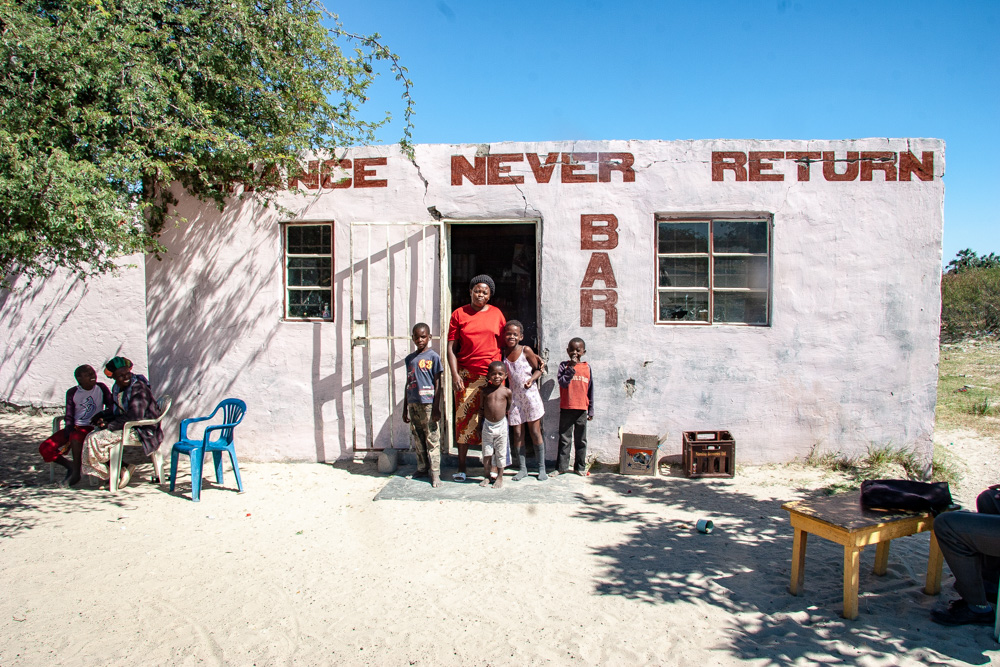
We camp in Cham-Cham behind a small family-owned pub.

  • Digg
  • del.icio.us
  • Yahoo! Buzz
  • Google Buzz
  • Twitter
  • Facebook
(No Comments)